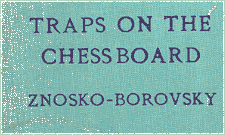
First comes from a position in the Znosko Borovsky book.
If Black plays 1...Nxf4 what is the White continuation.
1... Nxf4 2. Nf6+ Kf8 3. Rd8+ Bxd8 4. Re8 mate.
However, and Znosko Borovsky makes no mention of this when he is discussing (trap No.18) What is Black’s best move instead of 1...Nxf4.
1... Rxg2+ 2. Kxg2 Nxf4+ and 3....Nd3 Black is looking very good.
This next one I set for the kids. 50% of them walked into to the trap.
White to play and win.
The trap
1. Rxh3 Rxh3 2. f8=Q Re3+ Followed by 3.Rf3+ and Rxf1.
Solution
1. Rf5 Rxf5 2. Kxf5 h2 3. f8=Q h1=Q 4. Qa8+
A classic but some may not know it. F. Parr - G. Wheatcroft, London 1938.
White to play and win.
This is beautiful. Going through the variations is like being at an expensive buffet. You see one mouth watering dish and then you notice something else.
It also shows how narrow the path chess players tread between immortality and a haunting disaster. Just imagine for one awful minute Frank Parr had missed this mate. Instead of something to be proud off it would be a perpetual nightmare.
We shall build up to the Parr - Wheatcroft position and see the finale.
Header
FEN
r3r1k1/pp3pbp/4b1p1/q2n4/4N3/BQ2P1P1/P4PBP/2R2RK1 w - - 0 1
PGN
[FEN "r3r1k1/pp3pbp/4b1p1/q2n4/4N3/BQ2P1P1/P4PBP/2R2RK1 w - - 0 1"] 1. Rc5 {White re-positions their pieces by attacking the Queen.} 1... Qb6 {Black offers the Queens off. White is not interested.} 2. Rb5 Qa6 3. Nc5 Nxe3 {With this discovered on the White Queen Black hopes to cloud the issue.} 4. Nxe6 Nxf1 5. Ng5 {With a hit on f7 which Black ignores, it is just a check so save the f1 Knight.} 5... Nd2 6. Qxf7+ Kh8 {White now has a perpetual. 7.Qg8+ Kxg8 8. Bd5+ Kh8 9. Nf7+ and Nh6+ etc.} 7. Bd5 {But this threatens 8.Qg8+ Rxg8 9.Nf7 mate.} 7... h6 {Luft to prevent the smothered mates.} 8. Bb2 {Now threatening mate on g7.} 8... Rg8 9. Qd7 {Delightful. If 9....hxg5 10.Qh3 mate.} 9... Qa4 {A fighting defence. Pinning the Rook to the Queen and threatening mate in two with 10...Qd1+} 10. Bb3 {Stops the Qd1+ idea and clears the path to the h-file for the Rook.} 10... Nxb3 {We are now at the puzzle position.} 11. Nf7+ Kh7 {And now the star move.} 12. Rh5 {In the game Black played 12...Qa5 13.Rxh6+ Bxh6 14.Ng5+ and it mate with Qh7. The other line is,,,,} 12... Qxd7 13. Ng5+ {The h6 pawn is pinned.} 13... Kh8 14. Rxh6 {Checkmate. Wonderful.}
As usual I like to use RHP games. I searched the RHP database for this pattern.
Nothing of note for White or a Black mirrored position popped up.
So I removed the Bishop and replaced it with a pawn.
Success! First we look at ashtonkroz - Telboy 2 RHP 2011
Header
FEN
4r1k1/1p3p1p/p1p3p1/8/1P6/P4Q1P/1BPq1nP1/2R4K w - - 0 29
PGN
[FEN "4r1k1/1p3p1p/p1p3p1/8/1P6/P4Q1P/1BPq1nP1/2R4K w - - 0 29"] 29. Kh2 Re3 {Same as the master puzzle, the Rook gets into position with a hit on the Queen.} 30. Qf6 {Again as in the puzzle A mate is being threatened.} 30... Rxh3+ {If Kg1 then Rh1 is a mate.} 31. gxh3 {The discovered check....} 31... Ng4+ 32. Kg1 Nxf6 {...picked up the Queen and White resigned.} 0-1
That was one a Black win, unfortunately; tokyotower - Crypto RHP .2009
Header
FEN
6k1/r2q1ppp/pp6/2bB4/P1P2P2/1Q5P/1P1BrnPK/R4R2 w - - 0 1
PGN
[FEN "6k1/r2q1ppp/pp6/2bB4/P1P2P2/1Q5P/1P1BrnPK/R4R2 w - - 0 1"] 1. Bb4 Re3 {Once again the Rook uses the opposing Queen to set itself up for Rxh3+} 2. Qc2 Rxh3+ 3. gxh3 Qxh3+ 4. Kg1 {Black can now win with 4...Qg3+ 5.Bg2 Ng4+ because 6.Bxc5 Qh2 is mate but alas....} 4... Be3 {Black missed the mate in the previous note and thought they could not allow Bxc5.} 5. Rxf2 Bxf2+ {There is nothing any better, Black had their chance but dropped the ball.} 6. Qxf2 {Black resigned.}