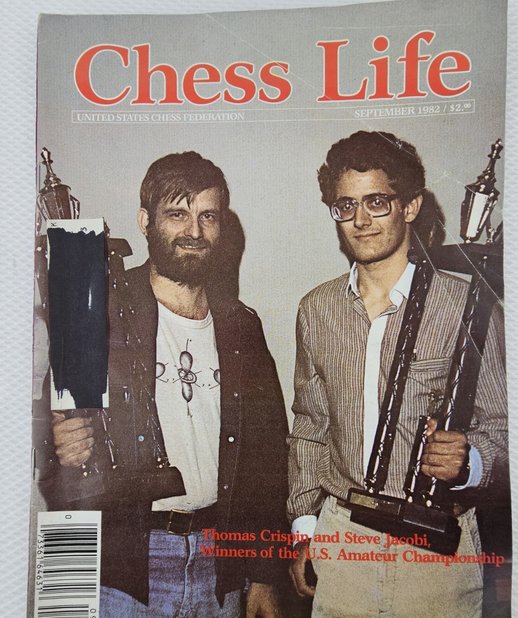
When I saw this Chess Life I thought the chap on the right was a young Fabiano Caruana.
It was only when I looked at the date, September 1982 did I realised that it can’t be. That lad on the right is Steve Jacobi who tied with Thomas Crispin (left) for the 1982 U.S.A. Amateur Championship. (I still think it is Caruana and he is an ageless vampire.)
Fabiano Caruana (or an older Steve Jacobi)
X. Jun - P. Harikrishna. Tripoli 2004 (Black to play)
I tired to solve it from the diagram. I dislike solving ‘Black to play’ puzzles and that is my excuse for getting it wrong. I saw the idea but used the incorrect move order.
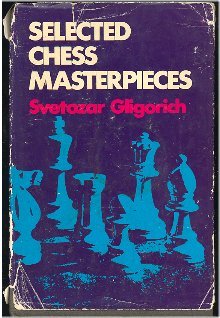
It is a collection of Gligoric’s Chess Review articles from 1965 - 1969. first-class notes, analysis and anecdotes. A book that should be reprinted in an algebraic edition.
B. Larsen - B. Ivkov, Spain 1967 A position arose that has appeared in many Over The Board (OTB) games.
Play soon deviated but Gligoric was wondering how far complete symmetry can go in any game reaching any position before White cashes in due to the fact they move first.
There is a famous Capablanca copycat position reached after 10 moves.
White played 11.Ne7+ Kh8 12 Bxg7+ Kxg7 Qg5 + 1-0.
And not forgetting this week’s cartoon game BIST - jlally RHP 2011
Header
PGN
1. e4 e5 2. d4 d5 3. f4 f5 {So far seen on RHP 29 times.} 4. fxe5 {Black now has 4...Qh4+ but this next move...} 4... fxe4 {...is more fun. White can now play Qh5+ but instead they stop Black from playing Qh4+} 5. h4 {White is again threatening Qh5+} 5... h5 {To stop White from playing Qh4+} 6. Bg5 Bg4 7. Be2 Be7 8. Bxe7 {And now the copying is over though there appears to be nothing wrong with Bxe2} 8... Qxe7 9. Bxg4 hxg4 10. Qxg4 Qb4+ 11. Nc3 Qxb2 {White should now play 12.Qc8+ Kf7 Qxc7+ which protects the c3 Knight.} 12. Rb1 Qxc3+ {The copying over, we shall leave this one, suffice to say White, yes White, somehow went onto win}
Next to step up is FBrosch - Josef Seibel RHP 2009 where after nine moves a position is reached seen 60 times on RHP White wins 25 Blacks wins 26!
Header
PGN
1. c4 Nf6 2. Nc3 g6 3. g3 Bg7 4. Bg2 O-O 5. Nf3 c5 6. O-O d6 7. d3 Nc6 8. Bd2 Bd7 9. Rc1 Rc8 {Now the mimicking stops.} 10. Re1 a6 11. Ng5 {A plan. White wants to play Nd5 without allowing Nxd5 so this is to swap off the f6 Knight.} 11... h6 12. Nge4 Nxe4 13. Bxe4 f5 {I prefer Black but I have always given a nod to whoever gets in f4 or f5 first.} 14. Bg2 e5 {Looks OK. A big centre grab, but that d5 square, which the White Knight was playing to occupy. now looks even more tempting.} 15. Nd5 {I like Knights on d5, they can get up to mischief. Black takes immediate steps to shift it.} 15... Be6 {Perhaps not with the Bishop. Use the Knight 15...Ne7.} 16. Qb3 {Black now defends the b-pawn, a move I would never have played. I'd have gone for 16...Nd4 I also like Knights on d4. 17 Qxb2 Rb8. and Rxb2 with f5 -f4 ideas.} 16... Rb8 17. Qb6 {White sensing a storm brewing with f5-f4 hovering over the table seeks more tepid waters.} 17... Qd7 {Black declines.. f5-f4, Bh3, Nd5 are all in the wind, both players can feel the breeze.} 18. Qc7 {White forces the Queen off. Black attempts to save a tempo by getting things rolling on the Queenside.} 18... b5 {OOPS! The d5 Knight has the final say.} 19. Qxc6 Qxc6 20. Ne7+ {Followed by Nxc6 and White resigned.}